When you join two independent clauses with a comma and no conjunction or full stop to separate them, it’s called a comma splice. Some people consider this a type of run-on sentence, while other people think of it as a punctuation error.
For example:
I went to the store, I bought apples.
Should be:
I went to the store. I bought apples.
OR
I went to the store and I bought some apples.
Can you correct these by adding the correct punctuation or joining the clauses with suitable conjunctions?
✏️ Fix the Comma Splice
The rain was pouring down, we forgot our umbrellas.
I love reading books, my sister prefers watching TV.
The dog barked loudly, the postman looked frightened.
We went to the park, it was closed.
Tom finished his homework, he went outside to play.
RIC
R
I
C
Wednesday 4th March 2026
LC: To explain the meaning of key vocabulary within the context of the text.
Shared reading:
🌿 The Secret of Willow Pond
Maya loved exploring the narrow path behind her grandmother’s cottage. The path twisted and turned through a tangle of bushes before opening into a small clearing. In the centre lay Willow Pond, its surface smooth and glimmering in the afternoon sunlight.
One warm Saturday, Maya noticed something unusual. The water, usually calm and peaceful, was rippling as if something was moving beneath it. She stepped closer, her heart beating rapidly. Suddenly, a silver shape darted across the pond and disappeared under the drooping willow branches.
Maya felt a mixture of excitement and fear. She was naturally curious, but she was also cautious. Taking a deep breath, she knelt by the edge and peered into the water. To her surprise, she saw a tiny wooden box resting among the reeds.
The box looked old and fragile, as though it might crumble if touched too roughly. Carefully, Maya reached in and lifted it out. Inside was a faded map and a note written in looping handwriting:
“For the one who is brave enough to discover the hidden treasure.”
Maya’s eyes widened. This was an extraordinary discovery! She realised that Willow Pond had been hiding secrets all along — and she had been brave enough to find one.
Shared comprehension
📘 Meaning of Words in Context Questions
1. What does the word “tangle” suggest about the bushes?
a) They were neatly trimmed b) They were messy and twisted together c) They were colourful d) They were very tall
2. The word “glimmering” tells us that the pond was:
a) Dirty and muddy b) Shaking wildly c) Shining softly d) Completely dry
3. What does “curious” mean in this story?
a) Angry and upset b) Wanting to find out more c) Tired and bored d) Ready to leave
4. The word “fragile” shows that the box was:
a) Very heavy b) Strong and hard c) Easily broken d) Locked tightly
5. If something is “extraordinary”, it is:
a) Very ordinary b) Unusual and special c) Small and hidden d) Difficult to understand
Adapted
🐰 The Rainy Day Surprise
Lily woke up and heard the rain tapping on her window. Dark clouds filled the sky, and the garden looked gloomy.
“I can’t play outside today,” Lily sighed.
She sat on the sofa feeling disappointed. She had planned to ride her scooter in the park. The day felt long and quiet.
Just then, Mum came into the room with a mysterious smile. She placed a large box on the table.
“What’s that?” Lily asked.
“Open it and see,” Mum said.
Inside the box was a bright yellow raincoat covered in shiny stars. Lily’s face lit up with delight.
Soon, Lily was splashing in puddles, laughing as the rain dripped from her hood. The gloomy day did not feel gloomy anymore!
📘 Meaning of Words in Context Questions
1. What does the word “gloomy” mean in the story?
a) Bright and sunny b) Dark and a little sad c) Very hot
2. If Lily felt “disappointed”, she felt:
a) Happy b) Angry c) Sad because something did not happen
3. The word “mysterious” suggests that Mum’s smile was:
a) Normal and boring b) Secret or exciting c) Cross and angry
4. What does “delight” mean?
a) Great happiness b) Fear c) Tiredness
Adapted
Wednesday 4th March 2026
LC: To write a narrative story opening- independent.
Using your plan write a narrative story opening with your innovated characters and animal.
04.03.26
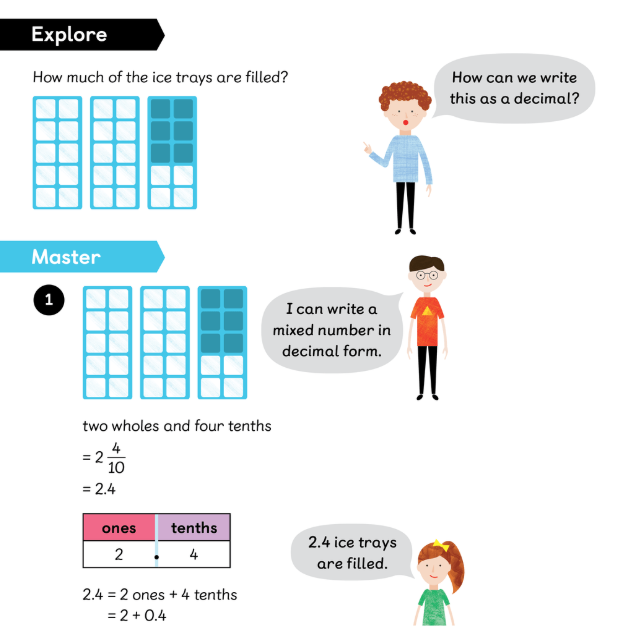
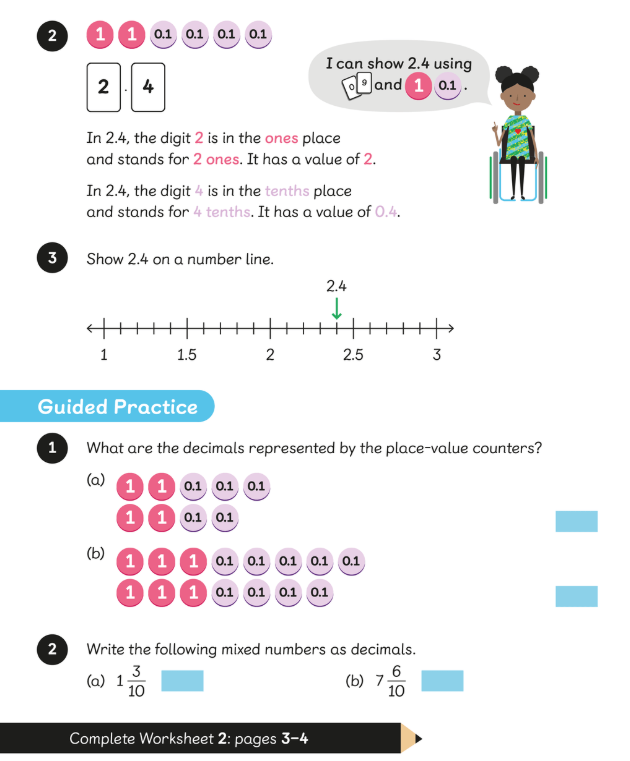
LC: To be able to recognise and write decimal equivalents of any number of tenths.
Adapted
Review
LC: Use apostrophes to spell words using the contracted form. Use apostrophes to spell words with singular possession.
Rule Detective: Contraction or Possession?
It was difficult to believe the child's story.
I didn't do my grammar homework this week.
The bird's wing got caught making it difficult to fly.
The magician's most recent trick made the dove disappear.
Learning
Focus: Use apostrophes to spell words for singular possession.
Watch me how to model sentences for each of the names and the object that belongs to that person.
Miss Reid car
Mrs Khatun coat
Apply
Saara Hamza Mr Ahmed Samina
Aysha Ali Kalim Miss Rehman
book bag
PE kit
tie
jumper
pencil
register
glove
sticker
Choose a name to write next to each object. Write them in your book, showing that the object belongs to that person.
Wednesday 4th March 2025
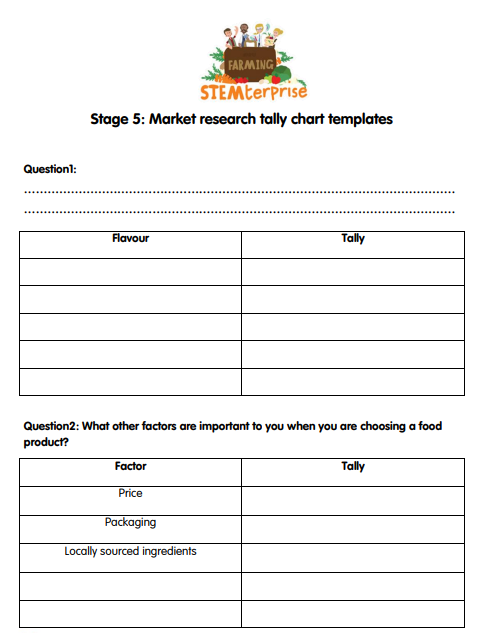
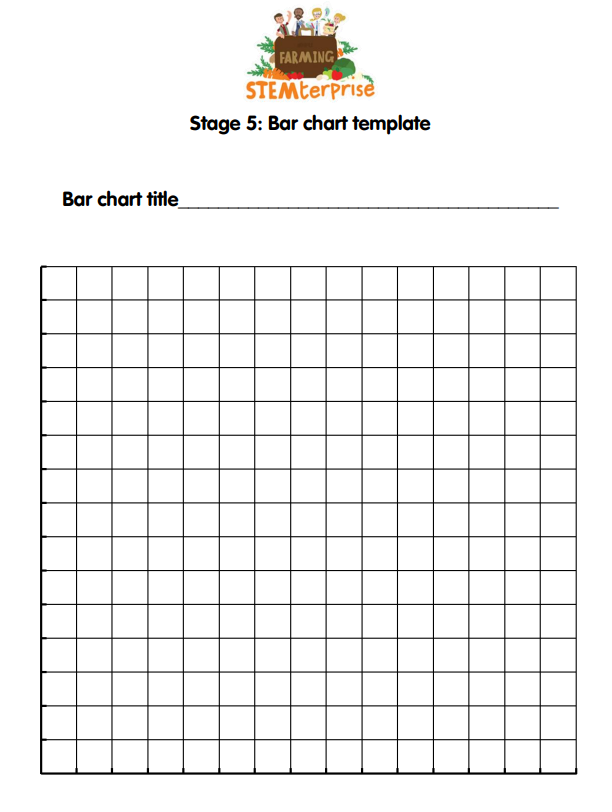
LC: Todesign and conduct a survey and present your findings using a bar chart.
Imagine that above your head, there is a little speaker. But this speaker doesn’t play your words — it plays your actions.
So when you say, “I’m kind,” the speaker plays what you actually do. When you say, “I’ll help,” the speaker shows whether you really helped. When you say, “It wasn’t me,” the speaker shows the truth.
Which one would be louder — your words or your actions?
Sometimes words are easy. We can say “sorry” quickly. We can say “I’ll try.” We can say “I didn’t mean to.”
But actions take effort. Actions take courage. Actions take honesty.
If you see someone sitting alone and you invite them to play — that action speaks. If you drop litter and no one sees you, but you pick it up anyway — that action speaks. If you make a mistake and tell the truth — that action speaks loudly.
Your actions are like your shadow. They follow you everywhere. People might forget what you said, but they remember how you behaved.
So today, before you speak, ask yourself:
Will my actions match these words?
Am I being someone others can trust?
If my actions were louder than my voice, what would people hear?
Let’s try to be people whose actions shout kindness, honesty, and respect — even when we don’t say a word.
Because in the end, actions really do speak louder than words.





 C
C