



Safeguarding at Stoneyholme Community Primary
At Stoneyholme Community Primary, the safety and well-being of our students is our utmost priority. We are committed to creating a secure and supportive environment where children can thrive academically and socially. Our safeguarding policies are designed to protect every child from harm and ensure that they feel safe and valued within our school community.
We understand that parents play a crucial role in safeguarding their children. We encourage open communication between parents and staff to ensure that any concerns are addressed promptly and effectively. Our team is trained to recognise the signs of abuse and neglect, and we work closely with local authorities and specialist agencies to provide the necessary support for our families.
Stoneyholme Community Primary actively promotes a culture of vigilance and care. We provide regular training for our staff and engage with our students to educate them about personal safety and awareness. Together, we can foster a safe environment where children are empowered to speak up and seek help, ensuring that every child at our school can learn and grow in a protective atmosphere.
Designated Safeguarding Leads
Keeping Children Safe in Education 2020 says
'It could happen here…'
If you have a concern about a child, please discuss with your DSL immediately.
DSL details:
Name: Lisa Wilkinson
Role: Children & Family Support Lead
Deputy DSL details:
Name: Jayne Fernandes
Role: Assistant Head
Name: Anne Reid
Role: Middle leader
Name: Luanne Galawan
Role: School Business Manager
In the rare event of not being able to contact a DSL, or for concerns out of school hours, YOU can seek advice or make a referral to Children's Social Care or the NSPCC using the numbers below.
Schools Safeguarding Helpline: 01772 531196
Children's Social Care: 0300 123 6720
Children's Social Care Out of Hours Team: 0300 123 6722
NSPCC: 0808 800 5000 or you can report concerns online anonymously using the www.NSPCC.org.uk website.
If you have concerns about the conduct of any adult in school, either staff or visitor please report directly to the Headteacher.
SAFEGUARDING IS EVERYONE'S RESPONSIBILITY.
Operation Encompass
Operation Encompass Parents Awareness Letter
Dear Parent/Carer,
This letter is to inform you / remind you that our school/ college is participating in Operation Encompass.
Operation Encompass is a unique Police and Education early intervention safeguarding partnership which ensures that a child/ young person's school/ college is informed, prior to the start of the next school day, that there has been a domestic abuse, vulnerable child or missing incident to which the child or young person has been exposed, and which might then have an impact on them in school/ college the following day.
Each school/ college is informed of all such incidents, not just those where an offence can be identified or those which are graded as high risk. The partnership recognises that all domestic abuse, vulnerable child and missing incidents can be harmful to children and young people.
This information will be shared throughout the year, including holidays and weekends. Information will only be shared with the school/ college by the police where it is identified that a young person was present, witnessed or was involved.
A nominated member of staff, known as a Key Adult, has been trained to liaise with the police. At insert school name our Key Adult is insert details. They will be able to use information that has been shared with them, in confidence, to ensure that the school makes provision for possible difficulties experienced by children or their families. The Key Adults will keep this information confidential and will only share it on a need to know basis, for instance, to teaching staff for the child or young person. It will not be shared with other school students.
This national initiative has been implemented across the whole of the Lancashire Police area. If you would like some more information about it, you can view it online at www.operationencompass.org.
We are keen to offer the best support possible for our pupils and a recent review of Operation Encompass showed that it is beneficial and supportive for all those involved.
Yours sincerely,
Majid Hussain Lisa Davison
Acting Chair of Governors Head Teacher
Pan Lancashire Operation Encompass
The purpose of Operation Encompass is to safeguard and support children and young people who have been involved in or witness to a domestic abuse, vulnerable child or missing incident.
Operation Encompass has been created to address such situations that create a safeguarding risk to young people. It is the implementation of key partnership working between the police and schools/ colleges. The aim of sharing information with local schools/ colleges is to allow ‘Key Adults’ the opportunity of engaging with the child and to provide access to support that allows them to remain in a safe but secure familiar environment.
Following the report of a domestic abuse, vulnerable child or missing incident, by
9.00am on the next school/ college day the school’s Key Adult will be informed of the child or young person’s involvement. This knowledge, given to educational establishments through Operation Encompass, allows the provision of immediate early intervention through silent or overt support dependent upon the needs and wishes of the child/ young person.
The purpose and procedures in Operation Encompass have been shared with all parents and governors, is detailed as part of the school’s Safeguarding Policy and published on our school website.
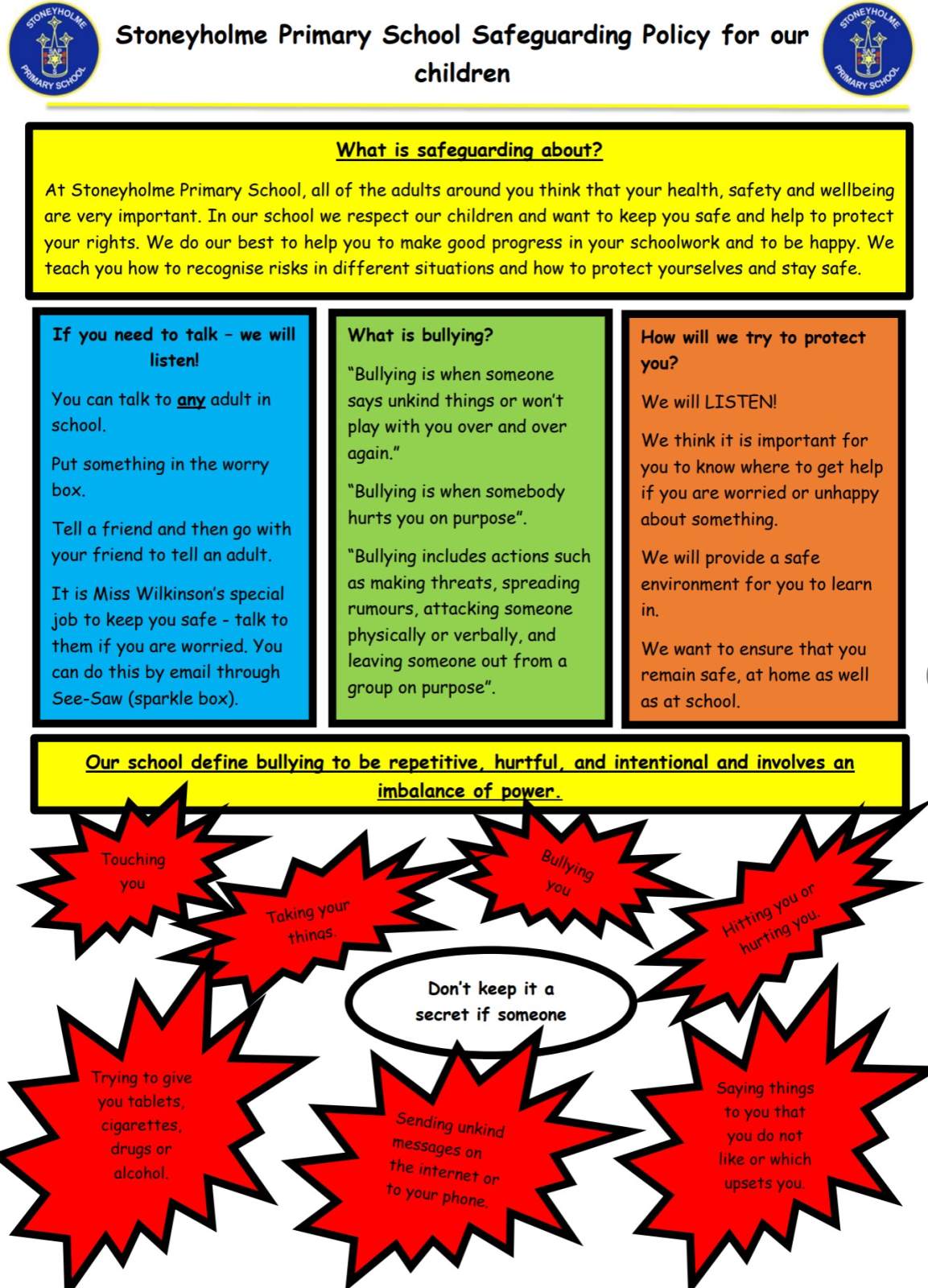
Safeguarding Policy
Child Friendly Policy
Acceptable Use Policies
Accessible Use Policy for Parents
-
I understand that Stoneyholme Community Primary School uses technology as part of the daily life of the school when it is appropriate to support teaching & learning and the smooth running of the school, and to help prepare the children and young people in our care for their future lives.
-
I understand that the school takes every reasonable precaution to keep pupils safe and to prevent pupils from accessing inappropriate materials, including behaviour policies and agreements, education and support and web filtering.
-
I understand that internet and use of school-owned devices, networks and cloud platforms out of school may be subject to filtering and monitoring. These should be used in the same manner as when in school.
-
I will promote positive online safety and model safe, responsible and positive behaviours in my own use of technology, including on social media: not sharing other’s images or details without permission and refraining from posting negative, threatening or violent comments about others, including the school staff, volunteers, governors, contractors, pupils or other parents/carers.
-
The impact of social media use is often felt strongly in schools, which is why we expect certain behaviours from pupils when using social media. I will support the school’s social media policy and not encourage my child to join any platform where they are below the minimum age.
-
I will follow the school’s Online Safety Policy, which outlines when I can capture and/or share images/videos. I will not share images of other people’s children on social media and understand that there may be cultural or legal reasons why this would be inappropriate or even dangerous. The school sometimes uses images/video of my child for internal purposes such as recording attainment, but it will only do so publicly if I have given my consent when my child joined the school.
-
I understand that for my child to grow up safe online, s/he will need positive input from school and home, so I will talk to my child about online safety (NB: the recent LGfL DigiSafe survey of 40,000 primary and secondary pupils found that 73% of pupils trust their parents on online safety, but only half talk about it with them more than once a year). Understanding human behaviour is more helpful than knowing how a particular app, site or game works.
-
I understand that whilst home networks are much less secure than school ones, I can apply child safety settings to my home internet. Internet Matters provides guides to help parents do this easily for all the main internet service providers in the UK.
-
I understand and support the commitments made by my child in the Acceptable Use Policy (AUP) which s/he has signed and I understand that s/he will be challenged if s/he does not follow these rules.
-
I can find out more about online safety at Stoneyholme Community Primary School by reading the full online Safety Policy, available on the website, and can talk to my child’s class teacher and IT lead (drop in every Friday morning in the school lodge) if I have any concerns about my child/ren’s use of technology, or about that of others in the community, or if I have questions about online safety or technology use in school.
Accessible Use Policy for KS1 Children
-
I will only use a computer when an adult tells me I can.
-
I will keep my password safe and not share it with anyone.
-
I will always send polite messages.
-
I will tell an adult if I see something on the computer that makes me unhappy.
Accessible Use Policy for KS2 Children
-
I will ask permission before using the Internet and use it for a specific purpose.
-
I will only use activities that a teacher or suitable adult has told or allowed me to use.
-
I will take care of all computing equipment.
-
I will never share my personal details, such as my full name or address, with people I don’t know.
-
I will never share my password with anyone.
-
I will always tell an adult if something on the Internet makes me or my friends unhappy, or if I think I have done something wrong.
-
I know that if I use the internet inappropriately, I might not be allowed to use a computer / ipad.
-
I will never meet up with someone I have met on the Internet.
-
I will always check my messages are polite before I send them.
-
I will not reply to a message that isn’t kind, but I will save it and show it to an adult.
-
I will not open or download a file unless I am sure it is safe.
-
I know I should not believe everything I read on the Internet.
Online Safety Policy
The DSL has now been asked to take lead responsibility for webfiltering and monitoring, marking a clear shift. Schools now need to follow the new DfE standards and consider the roles and responsibilities of all staff – for DSLs and SLT, the challenge is to better understand, review and drive the rationale behind decisions in this area. Tech teams and safeguarding teams will need to work much more closely together for this to be possible and technicians will be charged to carry out regular checks and feed back to DSL teams. All staff need to be aware of the changes and renewed emphasis and play their part in feeding back about overblocking or gaps in the filtering provision. Schools will also be reviewing their approaches to monitoring in line with the standards (note that filtering and monitoring are not the same – there is guidance around this for DSLs at https://safefiltering.lgfl.net).
|
Introduction |
||
|
Key people / dates |
||
|
Designated Safeguarding Lead (DSL), with lead responsibility for filtering and monitoring |
Lisa Wilkinson |
|
|
Deputy Designated Safeguarding Leads / DSL Team Members |
Luanne Galawan Jayne Fernades Anne Reid |
|
|
Jenna Bradshaw -PSHCE |
Stephen Aitken- Computing |
|
|
Network manager / other technical support |
Stephen Aitken |
|
|
Date this policy was reviewed and by whom |
Sept 2025- Luanne Galawan DSL |
|
|
Date of next review and by whom |
Sept 2026- Lisa Wilkinson DSL |
|
What is this policy?
Online safety is an integral part of safeguarding and requires a whole school, cross-curricular approach and collaboration between key school leads. Accordingly, this policy is written in line with ‘Keeping Children Safe in Education’ 2023 (KCSIE), ‘Teaching Online Safety in Schools’, statutory RSHE guidance and other statutory documents. It is cross-curricular (with relevance beyond Relationships, Health and Sex Education, Citizenship and Computing) and designed to sit alongside or be integrated into your school’s statutory Child Protection & Safeguarding Policy. Any issues and concerns with online safety must always follow the school’s safeguarding and child protection procedures.
Who is it for; when is it reviewed?
This policy should be a living document, subject to full annual review but also amended where necessary during the year in response to developments in the school and local area. Although many aspects will be informed by legislation and regulations, we will involve staff, governors, pupils and parents in writing and reviewing the policy and make sure the policy makes sense and it is possible to follow it in all respects. This will help ensure all stakeholders understand the rules that are in place and why, and that the policy affects day-to-day practice. Pupils could help to design a version in language their peers understand or help you to audit compliance. Acceptable Use Policies (see appendices) for different stakeholders help with this – ensure these are reviewed alongside this overarching policy. Any changes to this policy should be immediately disseminated to all the above stakeholders.
Who is in charge of online safety?
KCSIE makes clear that “the designated safeguarding lead should take lead responsibility for safeguarding and child protection (including online safety).” The DSL can delegate activities but not the responsibility for this area and whilst subject leads, e.g. for RSHE will plan the curriculum for their area, it is important that this ties into a whole-school approach.
What are the main online safety risks?
Current Online Safeguarding Trends
In our school over the past year, we have particularly noticed the following in terms of device use and abuse and types of online/device-based incidents which affect the wellbeing and safeguarding of our students: Content, anything posted online - it might be words or it could be images and video. Children and young people may see illegal, inappropriate or harmful content when online. This includes things like pornography, fake news, racism, misogyny, self-harm, suicide, anti-Semitism, radicalisation and extremism.
Nationally, some of the latest trends of the past twelve months are outlined below. These should be reflected in this policy and the acceptable use agreements we use, and seen in the context of the 4 Cs (see KCSIE for more details), a whole-school contextual safeguarding approach that incorporates policy and practice for curriculum, safeguarding and technical teams.
We may be updating this policy during the year to reflect any changes resulting from the Online Safety Bill being passed into law.
Self-generative artificial intelligence has been a significant change, with students having often unfettered access to tools that generate text and images at home or in school. These tools not only represent a challenge in terms of accuracy when young people are genuinely looking for information, but also in terms of plagiarism for teachers and above all safety: none of the mainstream tools have end-user safety settings, most have an age limit of 13 or even 18 and in spite of basic rude words not delivering results, will easily produce inappropriate material. Schools not only need to tackle this in terms of what comes into school but also educating young people and their parents on use of these tools in the home.
The continued cost-of-living crisis has meant that children have spent more time online and therefore exposed to all manner of online harms as families have had to cut back on leisure activities and the public provision of free activities for young people has reduced further.
Against this background, the Ofcom ‘Children and parents: media use and attitudes report 2023’ has shown that YouTube remains the most used site or app among all under 18s and the reach of WhatsApp, TikTok and Snapchat increased yet further. As a school we recognise that many of our children and young people are on these apps regardless of age limits, which are often misunderstood or ignored. We therefore remember to remind about best practice while remembering the reality for most of our students is quite different.
This is striking when you consider that 20% of 3-4 year olds have access to their OWN mobile phone (let alone shared devices), rising to over 90 percent by the end of Primary School, and the vast majority have no safety controls or limitations to prevent harm or access to inappropriate material. At the same time, even 3 to 6 year olds are being tricked into ‘self-generated’ sexual content (Internet Watch Foundation Annual Report) while considered to be safely using devices in the home and the 7-10 year old age group is the fastest growing for this form of child sexual abuse material, up 60 percent within 12 months to represent over 60,000 cases found (of this same kind where the abuser is not present).
In the past year, more and more children and young people used apps such as snapchat as their source of news and information, with little attention paid to the veracity of influencers sharing news. The 2023 Revealing-Reality: Anti-social-Media Report highlights that this content is interspersed with highly regular exposure to disturbing, graphic and illegal content such as fights, attacks, sexual acts and weapons. At the same time, the Children’s Commissioner revealed the ever younger children are regularly consuming pornography and living out inappropriate behaviour and relationships due to ‘learning from’ pornography. This has coincided with the rise of misogynistic influencers such as Andrew Tate, which had a significant influence on many young boys over the past year which schools have had to counter.
From the many schools that LGfL spoke to over the past year, there was a marked increase in the number of schools having issues with fights being filmed and shared, a disturbing increase in the cases of selfharm and sexual abuse being coerced with threats of violence (many even in primary schools).
There has been a significant increase in the number of fake profiles causing issues in schools, both for schools – where the school logo and/or name have been used to share inappropriate content about students and also spread defamatory allegations about staff, and also for students, including where these are used to bully others (sometimes even pretending to be one student to bully a second student).
How will this policy be communicated?
This policy can only impact upon practice if it is a (regularly updated) living document. It must be accessible to and understood by all stakeholders. It will be communicated in the following ways:
-
Posted on the school website
-
Part of school induction pack for all new staff (including temporary, supply and non-classroombased staff and those starting mid-year)
-
Integral to safeguarding updates and training for all staff (especially in September refreshers)
-
Clearly reflected in the Acceptable Use Policies (AUPs) for staff, volunteers, contractors, governors, pupils and parents/carers (which must be in accessible language appropriate to these groups), which will be issued to whole school community, on entry to the school, annually and whenever changed, plus displayed in school
Contents
What’s different about this policy for September 2023? 1
Introduction 1
Key people / dates 1
What is this policy? 2
Who is it for; when is it reviewed? 2
Who is in charge of online safety? 2
What are the main online safety risks in 2023/2024? 2
How will this policy be communicated? 4
Contents 4
Overview 7
Aims 7
Further Help and Support 7
Scope 8
Roles and responsibilities 8
Education and curriculum 8
Handling safeguarding concerns and incidents 10
Actions where there are concerns about a child 11
Sexting – sharing nudes and semi-nudes 13
Upskirting 14
Bullying 14
Child-on-child sexual violence and sexual harassment 14
Misuse of school technology (devices, systems, networks or platforms) 15
Social media incidents 15
Data protection and cybersecurity 17
Appropriate filtering and monitoring 17
Messaging/commenting systems (incl. email, learning platforms & more) 19
Authorised systems 19
Behaviour / usage principles 20
Online storage or learning platforms 20
School website 21
Digital images and video 21
Social media 22
Our SM presence 23
Staff, pupils’ and parents’ SM presence 23
Device usage 25
Personal devices including wearable technology and bring 25
your own device (BYOD)
Use of school devices 26
Trips / events away from school 26
Searching and confiscation 27
Appendix – Roles 28
All staff 28
Headteacher/Principal – L.Davison 28
Designated Safeguarding Lead / Online Safety Lead – L.Wilkinson / S.Aitken 30
Governing Body, led by Online Safety / Safeguarding Link Governor – L.Wilkinson 31
PSHE / RSHE Lead/s – J.Bradshaw 32
Computing Lead – S.Aitken 33
Subject / aspect leaders 33
Network Manager/other technical support roles – S.Aitken 34
Data Protection Officer (DPO) – L.Davison 35
Volunteers and contractors (including tutor) 35
Pupils 36
Parents/carers 36
External groups including parent associations – N/A 36
Overview
Aims
This policy aims to promote a whole school approach to online safety by:
-
Setting out expectations for all Stoneyholme Primary School community members’ online behaviour, attitudes and activities and use of digital technology (including when devices are offline)
-
Helping safeguarding and senior leadership teams to have a better understanding and awareness of all elements of online safeguarding through effective collaboration and communication with technical colleagues (e.g. for filtering and monitoring), curriculum leads (e.g. RSHE) and beyond.
-
Helping all stakeholders to recognise that online/digital behaviour standards (including social media activity) must be upheld beyond the confines of the school gates and school day, regardless of device or platform, and that the same standards of behaviour apply online and offline.
-
Facilitating the safe, responsible, respectful and positive use of technology to support teaching & learning, increase attainment and prepare children and young people for the risks and opportunities of today’s and tomorrow’s digital world, to survive and thrive online
-
Helping school staff working with children to understand their roles and responsibilities to work safely and responsibly with technology and the online world:
-
o for the protection and benefit of the children and young people in their care, and o for their own protection, minimising misplaced or malicious allegations and to better understand their own standards and practice
-
o for the benefit of the school, supporting the school ethos, aims and objectives, and protecting the reputation of the school and profession
-
-
Establishing clear structures by which online misdemeanours will be treated, and procedures to follow where there are doubts or concerns (with reference to other school policies such as Behaviour Policy or Anti-Bullying Policy)
Further Help and Support
Internal school channels should always be followed first for reporting and support, as documented in school policy documents, especially in response to incidents, which should be reported in line with your Child Protection & Safeguarding Policy. The DSL will handle referrals to local authority multi-agency safeguarding hubs (MASH) and normally the headteacher will handle referrals to the LA designated officer (LADO). The local authority, academy trust or third-party support organisations you work with may also have advisors to offer general support.
Beyond this, reporting.lgfl.net has a list of curated links to external support and helplines for both pupils and staff, including the Professionals’ Online-Safety Helpline from the UK Safer Internet Centre and the NSPCC Report Abuse Helpline for sexual harassment or abuse, as well as hotlines for hate crime, terrorism and fraud which might be useful to share with parents, and anonymous support for children and young people. Training is also available via safetraining.lgfl.net
Scope
This policy applies to all members of the Stoneyholme Primary School community (including teaching, supply and support staff, governors, volunteers, contractors, students/pupils, parents/carers, visitors and community users) who have access to our digital technology, networks and systems, whether onsite or remotely, and at any time, or who use technology in their school role.
Roles and responsibilities
This school is a community, and all members have a duty to behave respectfully online and offline, to use technology for teaching and learning and to prepare for life after school, and to immediately report any concerns or inappropriate behaviour, to protect staff, pupils, families and the reputation of the school. We learn together, make honest mistakes together and support each other in a world that is online and offline at the same time.
Depending on their role, all members of the school community should read the relevant section in Annex A of this document that describes individual roles and responsibilities. Please note there is one for All Staff which must be read even by those who have a named role in another section. There are also pupil, governor, etc role descriptions in the annex.
In 2023/2024, it is vital that all members understand their responsibilities and those of others when it comes to filtering and monitoring. All staff have a key role to play in feeding back on potential issues.
Education and curriculum
It is important that schools establish a carefully sequenced curriculum for online safety that builds on what pupils have already learned and identifies subject content that is appropriate for their stage of development.
As well as teaching about the underpinning knowledge and behaviours that can help pupils navigate the online world safely and confidently regardless of the device, platform or app, Teaching Online Safety in Schools recommends embedding teaching about online safety and harms through a whole school approach and provides an understanding of these risks to help tailor teaching and support to the specific needs of pupils, including vulnerable pupils – dedicated training around this with curriculum mapping for
RSHE/PSHE and online safety leads is available at safetraining.lgfl.net
RSHE guidance also recommends schools assess teaching to “identify where pupils need extra support or intervention [through] tests, written assignments or self evaluations, to capture progress.”
The following subjects have the clearest online safety links (see the relevant role descriptors above for more information):
-
Relationships education, relationships and sex education (RSE) and health (also known as RSHE or PSHE)
-
Computing
-
Citizenship
However, as stated in the role descriptors above, it is the role of all staff to identify opportunities to thread online safety through all school activities, both outside the classroom and within the curriculum, supporting curriculum/stage/subject leads, and making the most of unexpected learning opportunities as they arise (which have a unique value for pupils)
Whenever overseeing the use of technology (devices, the internet, new technology such as augmented reality, etc) in school or setting as homework tasks, all staff should encourage sensible use, monitor what pupils/students are doing and consider potential dangers and the age appropriateness of websites (ask your DSL what appropriate filtering and monitoring policies are in place). “Parents and carers are likely to find it helpful to understand what systems schools use to filter and monitor online use. It will be especially important for parents and carers to be aware of what their children are being asked to do online, including the sites they will be asked to access and be clear who from the school or college (if anyone) their child is going to be interacting with online” (KCSIE 2023).
Equally, all staff should carefully supervise and guide pupils when engaged in learning activities involving online technology (including, extra-curricular, extended school activities if relevant and remote teaching), supporting them with search skills, critical thinking (e.g. disinformation, misinformation and fake news), age appropriate materials and signposting, and legal issues such as copyright and data law. saferesources.lgfl.net has regularly updated theme-based resources, materials and signposting for teachers and parents.
At Stoneyholme Primary School we recognise that online safety and broader digital resilience must be thread throughout the curriculum and that is why we are working to adopt the cross-curricular framework ‘Education for a Connected World – 2020 edition’ from UKCIS (the UK Council for Internet Safety).
Annual reviews of curriculum plans / schemes of work (including for SEND pupils) are used as an opportunity to follow this framework more closely in its key areas of Self-image and Identity, Online relationships, Online reputation, Online bullying, Managing online information, Health, Wellbeing and lifestyle, Privacy and security, and Copyright and ownership.
Teach Computing – National Centre for Computing Education, other resources include Project Evolve and Twinkl.
Handling safeguarding concerns and incidents
It is vital that all staff recognise that online safety is a part of safeguarding (as well as being a curriculum strand of Computing, PSHE/RSHE and Citizenship).
General concerns must be handled in the same way as any other safeguarding concern; safeguarding is often referred to as a jigsaw puzzle, so all stakeholders should err on the side of talking to the onlinesafety lead / designated safeguarding lead to contribute to the overall picture or highlight what might not yet be a problem.
Support staff will often have a unique insight and opportunity to find out about issues first in the playground, corridors, toilets and other communal areas outside the classroom (particularly relating to bullying and sexual harassment and violence).
School procedures for dealing with online safety will be mostly detailed in the following policies (primarily in the first key document):
-
Safeguarding and Child Protection Policy
-
Behaviour Policy (including school sanctions)
-
Acceptable Use Policies
-
Data Protection Policy, agreements and other documentation (e.g. privacy statement and consent forms for data sharing, image use etc)
This school commits to take all reasonable precautions to ensure safeguarding pupils online, but recognises that incidents will occur both inside school and outside school (and that those from outside school will continue to impact pupils when they come into school or during extended periods away from school). All members of the school are encouraged to report issues swiftly to allow us to deal with them quickly and sensitively through the school’s escalation processes.
Any suspected online risk or infringement should be reported to the online safety lead / designated safeguarding lead on the same day – where clearly urgent, it will be made by the end of the lesson.
Any concern/allegation about staff misuse is always referred directly to the Headteacher, unless the concern is about the Headteacher in which case the complaint is referred to the Chair of Governors and the LADO (Local Authority’s Designated Officer). Staff may also use the NSPCC Whistleblowing Helpline (you may want to display a poster with details of this / other helplines in the staff room – see posters.lgfl.net and reporting.lgfl.net).
The school will actively seek support from other agencies as needed (i.e. the local authority, LGfL, UK
Safer Internet Centre’s Professionals’ Online Safety Helpline (POSH), NCA CEOP, Prevent Officer, Police, IWF and Harmful Sexual Behaviour Support Service). The DfE guidance Behaviour in Schools, advice for headteachers and school staff September 2022 provides advice and related legal duties including support for pupils and powers of staff when responding to incidents – see pages 32-34 for guidance on child on child sexual violence and harassment, behaviour incidents online and mobile phones.
We will inform parents/carers of online-safety incidents involving their children, and the Police where staff or pupils engage in or are subject to behaviour which we consider is particularly concerning or breaks the law (particular procedures are in place for sexting and upskirting; see section below).
The school should evaluate whether reporting procedures are adequate for any future closures/lockdowns/isolation etc and make alternative provisions in advance where these might be needed.
Actions where there are concerns about a child
The following flow chart (it cannot be edited) is taken from page 22 of Keeping Children Safe in Education 2022 as the key education safeguarding document. As outlined previously, online safety concerns are no different to any other safeguarding concern.
Sexting – sharing nudes and semi-nudes
All schools (regardless of phase) should refer to the UK Council for Internet Safety (UKCIS) guidance on sexting - now referred to as Sharing nudes and semi-nudes: advice for education settings to avoid unnecessary criminalisation of children. NB - where one of the parties is over 18, this is no longer sexting but child sexual abuse.
There is a one-page overview called Sharing nudes and semi-nudes: how to respond to an incident For all staff (not just classroom-based staff) to read, in recognition of the fact that it is mostly someone other than the designated safeguarding lead (DSL) or online safety lead to first become aware of an incident, and it is vital that the correct steps are taken. Staff other than the DSL must not attempt to view, share or delete the image or ask anyone else to do so, but to go straight to the DSL.
The school DSL will in turn use the full guidance document, Sharing nudes and semi-nudes – advice for educational settings (above) to decide next steps and whether other agencies need to be involved.
*Consider the 5 points for immediate referral at initial review:
-
The incident involves an adult
-
There is reason to believe that a child or young person has been coerced, blackmailed or groomed, or there are concerns about their capacity to consent (for example, owing to special educational needs)
-
What you know about the images or videos suggests the content depicts sexual acts which are unusual for the young person’s developmental stage, or are violent
-
The images involves sexual acts and any pupil in the images or videos is under 13
-
You have reason to believe a child or young person is at immediate risk of harm owing to the sharing of nudes and semi-nudes, for example, they are presenting as suicidal or self-harming
It is important that everyone understands that whilst sexting is illegal, pupils/students can come and talk to members of staff if they have made a mistake or had a problem in this area.
The documents referenced above and materials to support teaching about sexting can be found at sexting.lgfl.net
Upskirting
It is important that everyone understands that upskirting (taking a photo of someone under their clothing, not necessarily a skirt) is now a criminal offence and constitutes a form of sexual harassment as highlighted in Keeping Children Safe in Education. As with other forms of child on child abuse pupils/students can come and talk to members of staff if they have made a mistake or had a problem in this area.
Bullying
Online bullying, including incidents that take place outside school or from home should be treated like any other form of bullying and the school behaviour policy should be followed for online bullying, which may also be referred to as cyberbullying, including issues arising from banter.
It is important to be aware that in the past 12 months there has been an increase in anecdotal reports of fights being filmed and fake profiles being used to bully children in the name of others. When considering bullying, staff will be reminded of these issues.
Materials to support teaching about bullying and useful Department for Education guidance and case studies are at bullying.lgfl.net
Child-on-child sexual violence and sexual harassment
Part 5 of Keeping Children Safe in Education covers ‘Child-on-child sexual violence and sexual harassment’ and it would be useful for all staff to be aware of many aspects outlined there to support a whole-school response; case studies are also helpful for training.
Any incident of sexual harassment or violence (online or offline) should be reported to the DSL who will follow the full guidance. Staff should work to foster a zero-tolerance culture and maintain an attitude of ‘it could happen here’. The guidance stresses that schools must take all forms of sexual violence and harassment seriously, explaining how it exists on a continuum and that behaviours incorrectly viewed as ‘low level’ are treated seriously and not allowed to perpetuate. The document makes specific reference to behaviours such as bra-strap flicking and the careless use of language.
In the online environment, the recent proliferation of misogynistic content is particularly relevant when it comes to considering reasons for and how to combat this kind of behaviour.
Misuse of school technology (devices, systems, networks or platforms)
Clear and well communicated rules and procedures are essential to govern pupil and adult use of school networks, connections, internet connectivity and devices, cloud platforms and social media (both when on school site and outside of school).
These are defined in the relevant Acceptable Use Policy as well as in this document, for example in the sections relating to the professional and personal use of school platforms/networks/clouds, devices and other technology, as well as to BYOD (bring your own device) policy.
Where pupils contravene these rules, the school behaviour policy will be applied; where staff contravene these rules, action will be taken as outlined in the staff code of conduct/handbook.
It will be necessary to reinforce these as usual at the beginning of any school year but also to remind pupils that the same applies for any home learning that may take place in future periods of absence/ closure/quarantine etc.
Further to these steps, the school reserves the right to withdraw – temporarily or permanently – any or all access to such technology, or the right to bring devices onto school property.
The new responsibilities for filtering and monitoring, led by the DSL and following the new DfE standards, may mean that more such incidents will be discovered in the coming year.
Social media incidents
See the social media section later in this document for rules and expectations of behaviour for children and adults in the Stoneyholme Primary School community. These are also governed by school Acceptable Use Policies.
Breaches will be dealt with in line with the school behaviour policy (for pupils) or Staff Handbook (staff).
Further to this, where an incident relates to an inappropriate, upsetting, violent or abusive social media post by a member of the school community, Stoneyholme Primary School will request that the post be deleted and will expect this to be actioned promptly.
Where an offending post has been made by a third party, the school may report it to the platform it is hosted on, and may contact the Professionals’ Online Safety Helpline, POSH, (run by the UK Safer Internet Centre) for support or help to accelerate this process.
Data protection and cybersecurity
All pupils, staff, governors, volunteers, contractors and parents are bound by the school’s data protection and cybersecurity policy. It is important to remember that there is a close relationship between both data protection and cybersecurity and a school’s ability to effectively safeguard children. Schools are reminded of this in KCSIE which also refers to the DfE Standards of Cybersecurity for the first time in 2023.
Schools should remember that data protection does not prevent, or limit, the sharing of information for the purposes of keeping children safe. As outlined in Data protection in schools, 2023, “It’s not usually necessary to ask for consent to share personal information for the purposes of safeguarding a child.” And in KCSIE 2023, “The Data Protection Act 2018 and UK GDPR do not prevent the sharing of information for the purposes of keeping children safe. Fears about sharing information must not be allowed to stand in the way of the need to safeguard and promote the welfare and protect the safety of children.”
Appropriate filtering and monitoring
Keeping Children Safe in Education has long asked schools to ensure “appropriate” webfiltering and monitoring systems which keep children safe online but do not “overblock”.
Since KCSIE 2023, in recognition of the importance of these systems to keeping children safe, the designated safeguarding lead now has lead responsibility for filtering and monitoring (see page 1 for the DSL name and the named governor with responsibility for filtering and monitoring).
Schools are also asked to follow the new DfE filtering and monitoring standards, which require them to:
-
identify and assign roles and responsibilities to manage filtering and monitoring systems
-
review filtering and monitoring provision at least annually
-
block harmful and inappropriate content without unreasonably impacting teaching and learning
-
have effective monitoring strategies in place that meet their safeguarding needs
As schools get to grips with these new standards, the challenge for DSLs and SLT is to better understand, review and drive the rationale behind decisions in this area. Tech teams and safeguarding teams will need to work much more closely together for this to be possible and technicians will be charged to carry out regular checks and feed back to DSL teams.
ALL STAFF need to be aware of the changes and renewed emphasis and play their part in feeding back about areas of concern, potential for students to bypass systems and any potential overblocking. They can submit concerns at any point by speaking with the DSL or IT lead and will be asked for feedback at the time of the regular checks which will now take place.
Staff will be reminded of the systems in place and their responsibilities at induction and start of year safeguarding as well as via AUPs and regular training reminders in the light of the annual review and regular checks that will be carried out.
It is very important that schools understand the difference between filtering and monitoring, the meaning of overblocking and other terms, as well as how to get the best out of systems. There are guidance videos and flyers to help with this at https://safefiltering.lgfl.net and training is provided for all staff / safeguarding teams / technical teams as appropriate.
At Stoneyholme Primary School:
-
web filtering is provided by Netsweeper Cloud on school site and for school devices used in the home
-
changes can be made by Stephen Aitken
-
overall responsibility is held by the DSL with further support by the SLT.
-
technical support and advice, setup and configuration are from IT Lead
-
regular checks are made half termly by IT Lead to ensure filtering is still active and functioning everywhere. These are evidenced netsweeper daily reports are generated and check by the ICT lead, these reports include Suspicious Search Report, Prevent Report and Full Search Query Report.
-
an annual review is carried out
-
guidance on how the system is ‘appropriate’ is available at appropriate.lgfl.net According to the DfE standards, “a variety of monitoring strategies may be required to minimise safeguarding risks on internet connected devices and may include:
-
physically monitoring by staff watching screens of users
-
live supervision by staff on a console with device management software
-
network monitoring using log files of internet traffic and web access
-
individual device monitoring through software or third-party services
At Stoneyholme Primary School, we use :
Apple classroom to monitor live session use of iPads in the classroom, all devices are tagged in our |DHCP server and Netsweeper Cloud environment with the user's name and internet and web access is reported daily.
Messaging/commenting systems (incl. email, learning platforms & more)
Authorised systems
-
Pupils at this school communicate with each other and with staff using See-Saw
-
Staff at this school use the email system provided by Office 365 for all school emails. They never use a personal/private email account (or other messaging platform) to communicate with children or parents, or to colleagues when relating to school/child data, using a non-schooladministered system. Staff are permitted to use this email system to communicate with other staff members, parents and external organisations.
-
Staff at this school use our office 365 infrastructure to communicate with Staff, parents and external organisations
Any systems above are centrally managed and administered by the school or authorised IT partner (i.e. they can be monitored/audited/viewed centrally; are not private or linked to private accounts). This is for the mutual protection and privacy of all staff, pupils and parents, supporting safeguarding bestpractice, protecting children against abuse, staff against potential allegations and in line with UK data protection legislation.
Use of any new platform with communication facilities or any child login or storing school/child data must be approved in advance by the school and centrally managed. Any unauthorised attempt to use a different system may be a safeguarding concern or disciplinary matter and should be notified to the DSL (if by a child) or to the Headteacher (if by a staff member).
Where devices have multiple accounts for the same app, mistakes can happen, such as an email being sent from or data being uploaded to the wrong account. If this a private account is used for communication or to store data by mistake, the DSL/Headteacher/DPO (the particular circumstances of the incident will determine whose remit this is) should be informed immediately.
Behaviour / usage principles
-
More detail for all the points below are given in the Social media section of this policy as well as the school’s acceptable use agreements, behaviour policy and staff code of conduct.
-
Appropriate behaviour is expected at all times, and the system should not be used to send inappropriate materials or language which is or could be construed as bullying, aggressive, rude, insulting, illegal or otherwise inappropriate, or which (for staff) might bring the school into disrepute or compromise the professionalism of staff.
-
Data protection principles will be followed at all times when it comes to all school communications, in line with the school Data Protection Policy and only using the authorised systems mentioned above.
-
Pupils and staff are allowed to use the email system for reasonable (not excessive, not during lessons) personal use but should be aware that all use is monitored, their emails may be read and the same rules of appropriate behaviour apply at all times. Emails using inappropriate language, images, malware or to adult sites may be blocked and not arrive at their intended destination (and will be dealt with according to the appropriate policy and procedure).
Online storage or learning platforms
All the principles outlined above also apply to any system to which you log in online to conduct school business, whether it is to simply store files or data (an online ‘drive’) or collaborate, learn, teach, etc.
For all these, it is important to consider data protection and cybersecurity before adopting such a platform or service and at all times when using it. Stoneyholme Primary School has a clear cybersecurity and data protection policy which staff, governors and volunteers must follow at all times.
School website
The school website is a key public-facing information portal for the school community (both existing and prospective stakeholders) with a key reputational value. The Headteacher and Governors have delegated the day-to-day responsibility of updating the content of the website and ensuring compliance with DfE stipulations to ICT Lead and Business Manager
The site is managed by / hosted by Greenhouse School Websites.
Where staff submit information for the website, they are asked to remember that schools have the same duty as any person or organisation to respect and uphold copyright law – schools have been fined thousands of pounds for copyright breaches. Sources must always be credited and material only used with permission. There are many open-access libraries of public-domain images/sounds etc that can be used. Finding something on Google or YouTube does not mean that copyright has been respected. If in doubt, check with ICT Lead.
Digital images and video
When a pupil joins the school, parents/carers are asked if they give consent for their child’s image to be captured in photographs or videos, for what purpose (beyond internal assessment, which does not require express consent) and for how long. Parents answer as follows:
-
For displays around the school
-
For use in paper-based school marketing
-
For online prospectus or websites
-
For social media Etc.
Whenever a photo or video is taken/made, the member of staff taking it will check the latest database before using it for any purpose.
Any pupils shown in public facing materials are never identified with more than first name (and photo file names/tags do not include full names to avoid accidentally sharing them).
All staff are governed by their contract of employment and the school’s Acceptable Use Policy, which covers the use of mobile phones/personal equipment for taking pictures of pupils, and where these are stored. At Stoneyholme Primary School, no member of staff will ever use their personal phone to capture photos or videos of pupils.
Photos are stored on the local network and cloud platform in line with the retention schedule of the school Data Protection Policy.
Staff and parents are reminded annually about the importance of not sharing without permission, due to reasons of child protection (e.g. looked-after children often have restrictions for their own protection), data protection, religious or cultural reasons, or simply for reasons of personal privacy. Further detail on this subject and a sample letter to parents for taking photos or videos at school events can be found at parentfilming.lgfl.net
We encourage young people to think about their online reputation and digital footprint, so we should be good adult role models by not oversharing (or providing embarrassment in later life – and it is not for us to judge what is embarrassing or not).
Pupils are taught about how images can be manipulated in their online safety education programme and also taught to consider how to publish for a wide range of audiences which might include governors, parents or younger children
Pupils are advised to be very careful about placing any personal photos on social media. They are taught to understand the need to maintain privacy settings so as not to make public, personal information.
Pupils are taught that they should not post images or videos of others without their permission. We teach them about the risks associated with providing information with images (including the name of the file), that reveals the identity of others and their location. We teach them about the need to keep their data secure and what to do if they / or a friend are subject to bullying or abuse.
Social media
Our SM presence
Stoneyholme Primary School works on the principle that if we don’t manage our social media reputation, someone else will.
Online Reputation Management (ORM) is about understanding and managing our digital footprint (everything that can be seen or read about the school online). Few parents will apply for a school place without first Googling the school, and the Ofsted pre-inspection check includes monitoring what is being said online.
Negative coverage almost always causes some level of disruption. Up to half of all cases dealt with by the Professionals Online Safety Helpline (POSH: helpline@saferinternet.org.uk) involve schools’ (and staff members’) online reputation.
Accordingly, we manage and monitor our social media footprint carefully to know what is being said about the school and to respond to criticism and praise in a fair, responsible manner.
Mr Aitken is responsible for monitoring and editing our school X-Twitter/Facebook/and other social media accounts and checking our Wikipedia and Google reviews and other mentions online.
Staff, pupils’ and parents’ SM presence
Social media (including all apps, sites and games that allow sharing and interaction between users) is a fact of modern life, and as a school, we accept that many parents, staff and pupils will use it. However, as stated in the acceptable use policies which all members of the school community sign, we expect everybody to behave in a positive manner, engaging respectfully with the school and each other on social media, in the same way as they would face to face.
This positive behaviour can be summarised as not making any posts which are or could be construed as bullying, aggressive, rude, insulting, illegal or otherwise inappropriate, or which might bring the school or (particularly for staff) teaching profession into disrepute. This applies both to public pages and to private posts, e.g. parent chats, pages or groups.
If parents have a concern about the school, we would urge them to contact us directly and in private to resolve the matter. If an issue cannot be resolved in this way, the school complaints procedure should be followed. Sharing complaints on social media is unlikely to help resolve the matter, but can cause upset to staff, pupils and parents, also undermining staff morale and the reputation of the school (which is important for the pupils we serve).
Many social media platforms have a minimum age of 13 (note that WhatsApp is 16+), but the school regularly deals with issues arising on social media involving pupils/students under the age of 13. We ask parents to respect age ratings on social media platforms wherever possible and not encourage or condone underage use. It is worth noting that Online Harms regulation is likely to require more stringent age verification measures over the coming years.
However, the school has to strike a difficult balance of not encouraging underage use at the same time as needing to acknowledge reality in order to best help our pupils/students to avoid or cope with issues if they arise. Online safety lessons will look at social media and other online behaviour, how to be a good friend online and how to report bullying, misuse, intimidation or abuse. However, children will often learn most from the models of behaviour they see and experience, which will often be from adults.
Parents can best support this by talking to their children about the apps, sites and games they use (you don’t need to know them – ask your child to explain it to you), with whom, for how long, and when (late at night / in bedrooms is not helpful for a good night’s sleep and productive teaching and learning at school the next day). You may wish to refer to the Digital Family Agreement to help establish shared expectations and the Top Tips for Parents poster along with relevant items and support available from parentsafe.lgfl.net and introduce the Children’s Commission Digital 5 A Day.
Although the school has an official Facebook / X-Twitter / Instagram account and will respond to general enquiries about the school, it asks parents/carers not to use these channels, especially not to communicate about their children.
Email is the official electronic communication channel between parents and the school.
Pupils/students are not allowed* to be ‘friends’ with or make a friend request** to any staff, governors, volunteers and contractors or otherwise communicate via social media.
Pupils/students are discouraged from ‘following’ staff, governor, volunteer or contractor public accounts (e.g. following a staff member with a public Instagram account) as laid out in the AUPs. However, we accept that this can be hard to control (but this highlights the need for staff to remain professional in their private lives). In the reverse situation, however, staff must not follow such public student accounts.
* Exceptions may be made, e.g. for pre-existing family links, but these must be approved by the Headteacher/Principal, and should be declared upon entry of the pupil or staff member to the school).
** Any attempt to do so may be a safeguarding concern or disciplinary matter and should be notified to the DSL (if by a child) or to the Headteacher (if by a staff member).
Staff are reminded that they are obliged not to bring the school or profession into disrepute and the easiest way to avoid this is to have the strictest privacy settings and avoid inappropriate sharing and oversharing online. They should never discuss the school or its stakeholders on social media and be careful that their personal opinions might not be attributed to the school, trust or local authority, bringing the school into disrepute.
The serious consequences of inappropriate behaviour on social media are underlined by the fact that there has been a significant number of Prohibition Orders issued by the Teacher Regulation Agency to teaching staff that involved misuse of social media/technology.
All members of the school community are reminded that particularly in the context of social media, it is important to comply with the school policy on Digital images and video and permission is sought before uploading photographs, videos or any other information about other people.
The statements of the Acceptable Use Policies (AUPs) which all members of the school community have signed are also relevant to social media activity, as is the school’s Data Protection Policy.
Device usage
AUPs remind those with access to school devices about rules on the misuse of school technology – devices used at home should be used just like if they were in full view of a teacher or colleague. Please read the following in conjunction with those AUPs and the sections of this document which impact upon device usage, e.g. copyright, data protection, social media, misuse of technology, and digital images and video.
Personal devices including wearable technology and bring your own device (BYOD)
-
Pupils are NOT allowed to bring mobile phones.
-
All staff who work directly with children should leave their mobile phones on silent in their locker and only use them in private staff areas during school hours. See also the ‘Digital images and video’ section of this document and the school data protection cybersecurity policies. Child/staff data should never be downloaded onto a private phone. If a staff member is expecting an important personal call when teaching or otherwise on duty, they may leave their phone with the school office to answer on their behalf or ask for the message to be left with the school office. ● Volunteers, contractors, governors should leave their phones in their pockets and turned off. Under no circumstances should they be used in the presence of children or to take photographs or videos. If this is required (e.g. for contractors to take photos of equipment or buildings), permission of the headteacher should be sought (the headteacher may choose to delegate this) and this should be done in the presence of a member staff.
-
Parents are asked to leave their phones in their pockets and turned off when they are on site. They should ask permission before taking any photos, e.g. of displays in corridors or classrooms, and avoid capturing other children. When at school events, please refer to the Digital images and video section of this document. Parents are asked not to call pupils on their mobile phones during the school day; urgent messages can be passed via the school office.
Use of school devices
Staff and pupils are expected to follow the terms of the school acceptable use policies for appropriate use and behaviour when on school devices, whether on site or at home.
School devices are not to be used in any way which contravenes AUPs, behaviour policy / staff code of conduct.
Wifi is accessible to staff, pupils and guests for school-related internet use / limited personal use within the framework of the acceptable use policy. All such use is monitored.
School devices for staff or students are restricted to the apps/software installed by the school, whether for use at home or school, and may be used for learning.
All and any usage of devices and/or systems and platforms may be tracked.
Trips / events away from school
For school trips/events away from school, teachers will be issued a school duty phone and this number used for any authorised or emergency communications with pupils/students and parents. Any deviation from this policy (e.g. by mistake or because the school phone will not work) will be notified immediately to the Headteacher. Teachers using their personal phone in an emergency will ensure that the number is hidden to avoid a parent or student accessing a teacher’s private phone number.
Searching and confiscation
In line with the DfE guidance ‘Searching, screening and confiscation: advice for schools’, the Headteacher and staff authorised by them have a statutory power to search pupils/property on school premises. This includes the content of mobile phones and other devices, for example as a result of a reasonable suspicion that a device contains illegal or undesirable material, including but not exclusive to sexual images, pornography, violence or bullying.
Full details of the school’s search procedures are available in the school Behaviour Policy.
Appendix – Roles
Please read the relevant roles & responsibilities section from the following pages.
All school staff must read the “All Staff” section as well as any other relevant to specialist roles Roles:
-
All Staff
-
Headteacher/Principal
-
Designated Safeguarding Lead
-
Governing Body, led by Online Safety / Safeguarding Link Governor
-
PSHE / RSHE Lead/s
-
Computing Lead
-
Subject / aspect leaders
-
Network Manager/technician
-
Data Protection Officer (DPO)
-
Volunteers and contractors (including tutor)
-
Pupils
-
Parents/carers
-
External groups including parent associations
All staff
All staff should sign and follow the staff acceptable use policy in conjunction with this policy, the school’s main safeguarding policy, the code of conduct/handbook and relevant parts of Keeping Children Safe in Education to support a whole-school safeguarding approach.
This includes reporting any concerns, no matter how small, to the designated safety lead as named in the AUP, maintaining an awareness of current online safety issues (see the start of this document for issues in 2023) and guidance (such as KCSIE), modelling safe, responsible and professional behaviours in their own use of technology at school and beyond and avoiding scaring, victim-blaming language.
Staff should also be aware of the new DfE standards and relevant changes to filtering and monitoring and play their part in feeding back about overblocking, gaps in provision or pupils bypassing protections.
Headteacher – Lisa Davison
Key responsibilities:
Foster a culture of safeguarding where online-safety is fully integrated into whole-school safeguarding
-
Oversee and support the activities of the designated safeguarding lead team and ensure they work technical colleagues to complete an online safety audit in line with KCSIE (including technology in use in the school)
-
Undertake training in offline and online safeguarding, in accordance with statutory guidance and Local Safeguarding Children Partnership support and guidance
-
Ensure ALL staff undergo safeguarding training (including online-safety) at induction and with regular updates and that they agree and adhere to policies and procedures
-
Ensure ALL governors and trustees undergo safeguarding and child protection training and updates (including online-safety) to provide strategic challenge and oversight into policy and practice and that governors are regularly updated on the nature and effectiveness of the school’s arrangements. Ensure the school implements and makes effective use of appropriate ICT systems and services including school-safe filtering and monitoring, protected email systems and that all technology including remote systems are implemented according to child-safety first principles.
-
Better understand, review and drive the rationale behind decisions in filtering and monitoring as per the new DfE standards—through regular liaison with technical colleagues and the DSL– in particular understand what is blocked or allowed for whom, when, and how as per KCSIE. In 2023/4 this will involve starting regular checks and annual reviews, upskilling the DSL and appointing a filtering and monitoring governor
-
Liaise with the designated safeguarding lead on all online-safety issues which might arise and receive regular updates on school issues and broader policy and practice information
-
Support safeguarding leads and technical staff as they review protections for pupils in the home and remote-learning procedures, rules and safeguards. Take overall responsibility for data management and information security ensuring the school’s provision follows best practice in information handling; work with the DPO, DSL and governors to ensure a compliant framework for storing data, but helping to ensure that child protection is always put first and data-protection processes support careful and legal sharing of information
-
Understand and make all staff aware of procedures to be followed in the event of a serious online safeguarding incident
-
Ensure suitable risk assessments are undertaken so the curriculum meets needs of pupils, including risk of children being radicalised
-
Ensure the school website meets statutory requirements
Designated Safeguarding Lead / Online Safety Lead - Lisa Wilkinson
Key responsibilities (remember the DSL can delegate certain online-safety duties but not the overall responsibility; this assertion and all quotes below are from Keeping Children Safe in Education):
-
The DSL should “take lead responsibility for safeguarding and child protection (including online safety and understanding the filtering and monitoring systems and processes in place).
-
Ensure “An effective whole school approach to online safety as per KCSIE
-
In 2023/4 working to take up the new responsibility for filtering and monitoring by working closely with technical colleagues, SLT and the new filtering governor to learn more about this area, better understand, review and drive the rationale behind systems in place and initiate regular checks and annual reviews, including support for devices in the home.
-
Where online-safety duties are delegated and in areas of the curriculum where the DSL is not directly responsible but which cover areas of online safety (e.g. RSHE), ensure there is regular review and open communication and that the DSL’s clear overarching responsibility for online safety is not compromised or messaging to pupils confused
-
Ensure ALL staff and supply staff undergo safeguarding and child protection training (including online-safety) at induction and that this is regularly updated.
-
o In 2023/4 this must include filtering and monitoring and help them to understand their roles
-
o all staff must read KCSIE Part 1 and all those working with children also Annex B – translations are available in 13 community languages at lgfl.net (B the condensed Annex A can be provided instead to staff who do not directly work with children if this is better)
-
o cascade knowledge of risks and opportunities throughout the organisation lgfl.net has helpful CPD materials including PowerPoints, videos and more
-
-
Ensure that ALL governors and trustees undergo safeguarding and child protection training (including online-safety) at induction to enable them to provide strategic challenge and oversight into policy and practice and that this is regularly updated
-
Take day-to-day responsibility for safeguarding issues and be aware of the potential for serious child protection concerns
-
Be mindful of using appropriate language and terminology around children when managing concerns, including avoiding victim-blaming language
-
Remind staff of safeguarding considerations as part of a review of remote learning procedures and technology, including that the same principles of online-safety and behaviour apply
-
Work closely with SLT, staff and technical colleagues to complete an online safety audit (including technology in use in the school)
Work with the headteacher, DPO and governors to ensure a compliant framework for storing data, but helping to ensure that child protection is always put first and data-protection processes support careful and legal sharing of information
-
Stay up to date with the latest trends in online safeguarding and “undertake Prevent awareness training.” – see safetraining.lgfl.ne are based (in harmony with policies for behaviour, safeguarding, Prevent and others) and submit for review to the governors/trustees.
-
Receive regular updates in online-safety issues and legislation, be aware of local and school trends – see safeblog.lgfl.net for examples or sign up to the LGfL safeguarding newsletter
-
Ensure that online-safety education is embedded across the curriculum in line with the statutory
RSHE guidance (e.g. by use of the updated UKCIS framework ‘Education for a Connected World – 2020 edition’) and beyond, in wider school life
-
Promote an awareness of and commitment to online-safety throughout the school community, with a strong focus on parents, including hard-to-reach parents – dedicated resources at parentsafe.lgfl.net
-
Communicate regularly with SLT and the safeguarding governor/committee to discuss current issues (anonymised), review incident logs and filtering/change control logs and discuss how filtering and monitoring work and have been functioning/helping.
-
Ensure all staff are aware of the procedures that need to be followed in the event of an online safety incident, and that these are logged in the same way as any other safeguarding incident.
-
Ensure adequate provision for staff to flag issues when not in school and for pupils to disclose issues when off site, especially when in isolation/quarantine, e.g. a survey to facilitate disclosures and an online form on the school home page about ‘something that worrying me’ that gets mailed securely to the DSL inbox
-
Ensure staff adopt a zero-tolerance, whole school approach to all forms of child-on-child abuse, and don’t dismiss it as banter (including bullying).
-
Pay particular attention to online tutors, both those engaged by the school as part of the DfE scheme who can be asked to sign the contractor AUP, and those hired by parents.
Governing Body, led by Online Safety / Safeguarding Link Governor- Anisa Bibi
Key responsibilities (quotes are taken from Keeping Children Safe in Education)
-
Approve this policy and strategy and subsequently review its effectiveness, e.g. by asking the questions in the helpful document from the UK Council for Child Internet Safety (UKCIS) Online safety in schools and colleges: Questions from the Governing Board
-
Undergo (and signpost all other governors and Trustees to attend) safeguarding and child protection training (including online safety) at induction to provide strategic challenge and into policy and practice, ensuring this is regularly updated
Ensure that all staff also receive appropriate safeguarding and child protection (including online) training at induction and that this is updated
-
Appoint a filtering and monitoring governor to work closely with the DSL on the new filtering and monitoring standards
-
Support the school in encouraging parents and the wider community to become engaged in online safety activities
-
Have regular strategic reviews with the online-safety coordinator / DSL and incorporate online safety into standing discussions of safeguarding at governor meetings
-
Work with the DPO, DSL and headteacher to ensure a compliant framework for storing data, but helping to ensure that child protection is always put first and data-protection processes support careful and legal sharing of information
-
Check all school staff have read Part 1 of KCSIE; SLT and all working directly with children have read Annex B
-
Ensure that all staff undergo safeguarding and child protection training (including online safety and now also reminders about filtering and monitoring
-
“Ensure that children are taught about safeguarding, including online safety […] as part of providing a broad and balanced curriculum […] Consider a whole school or college approach to online safety [with] a clear policy on the use of mobile technology.”
PSHE / RSHE Lead/s – Fathima Khatun
Key responsibilities:
-
As listed in the ‘all staff’ section, plus:
-
Embed consent, mental wellbeing, healthy relationships and staying safe online as well as raising awareness of the risks and challenges from recent trends in self-generative artificial intelligence, financial extortion and sharing intimate pictures online into the PSHE / Relationships education, relationships and sex education (RSE) and health education curriculum. “This will include being taught what positive, healthy and respectful online relationships look like, the effects of their online actions on others and knowing how to recognise and display respectful behaviour online. Throughout these subjects, teachers will address online safety and appropriate behaviour in an age appropriate way that is relevant to their pupils’ lives.”
-
Focus on the underpinning knowledge and behaviours outlined in Teaching Online Safety in Schools in an age appropriate way to help pupils to navigate the online world safely and confidently regardless of their device, platform or app.
-
Assess teaching to “identify where pupils need extra support or intervention [through] tests, written assignments or self evaluations, to capture progress” and to complement the computing curriculum,.
-
Work closely with the DSL/OSL and all other staff to ensure an understanding of the issues, approaches and messaging within PSHE / RSHE.
Note that an RSHE policy should be included on the school website.
-
Work closely with the Computing subject leader to avoid overlap but ensure a complementary whole-school approach, and with all other lead staff to embed the same whole-school approach
Computing Lead – [ Stephen Aitken]
Key responsibilities:
-
As listed in the ‘all staff’ section, plus:
-
Oversee the delivery of the online safety element of the Computing curriculum in accordance with the national curriculum
-
Work closely with the RSHE lead to avoid overlap but ensure a complementary whole-school approach
-
Work closely with the DSL/OSL and all other staff to ensure an understanding of the issues, approaches and messaging within Computing
-
Collaborate with technical staff and others responsible for ICT use in school to ensure a common and consistent approach, in line with acceptable-use agreements
Subject / aspect leaders
Key responsibilities:
-
As listed in the ‘all staff’ section, plus:
-
Look for opportunities to embed online safety in your subject or aspect, especially as part of the RSHE curriculum, and model positive attitudes and approaches to staff and pupils alike
-
Consider how the UKCIS framework Education for a Connected World and Teaching Online Safety in Schools can be applied in your context
-
Work closely with the DSL/OSL and all other staff to ensure an understanding of the issues, approaches and messaging within Computing
-
Ensure subject specific action plans also have an online-safety element
Network Manager/other technical support roles – Stephen Aitken
Key responsibilities:
-
As listed in the ‘all staff’ section, plus:
Collaborate regularly with the DSL and leadership team to help them make key strategic decisions around the safeguarding elements of technology.
-
Note that KCSIE changes expect a great understanding of technology and its role in safeguarding when it comes to filtering and monitoring and in 2023/4 you will be required to support safeguarding teams to understand and manage these systems and carry out regular reviews and annual checks.
-
Support DSLs and SLT to carry out an annual online safety audit as now recommended in KCSIE. This should also include a review of technology, including filtering and monitoring systems (what is allowed, blocked and why and how ‘over blocking’ is avoided as per KCSIE) to support their role as per the new DfE standards, protections for pupils in the home and remote-learning.
-
Keep up to date with the school’s online safety policy and technical information in order to effectively carry out their online safety role and to inform and update others as relevant
-
Work closely with the designated safeguarding lead / online safety lead / data protection officer / LGfL nominated contact / RSHE lead to ensure that school systems and networks reflect school policy and there are no conflicts between educational messages and practice.
-
Ensure the above stakeholders understand the consequences of existing services and of any changes to these systems (especially in terms of access to personal and sensitive records / data and to systems such as YouTube mode, web filtering settings, sharing permissions for files on cloud platforms etc
-
Maintain up-to-date documentation of the school’s online security and technical procedures
-
To report online-safety related issues that come to their attention in line with school policy
-
Manage the school’s systems, networks and devices, according to a strict password policy, with systems in place for detection of misuse and malicious attack, with adequate protection, encryption and backup for data, including disaster recovery plans, and auditable access controls.
-
Ensure the data protection policy and cybersecurity policy are up to date, easy to follow and practicable. Monitor the use of school technology, online platforms and social media presence and that any misuse/attempted misuse is identified and reported in line with school policy
-
Work with the Headteacher to ensure the school website meets statutory DfE requirements
Data Protection Officer (DPO) – Luanne Galawan - Key responsibilities:
-
Alongside those of other staff, provide data protection expertise and training and support the DP and cybersecurity policy and compliance with those and legislation and ensure that the policies conform with each other and with this policy.
-
Not prevent, or limit, the sharing of information for the purposes of keeping children safe. As outlined in Data protection in schools, 2023, “It’s not usually necessary to ask for consent to share personal information for the purposes of safeguarding a child.” And in KCSIE 2023, “The Data Protection Act 2018 and UK GDPR do not prevent the sharing of information for the purposes of
keeping children safe. Fears about sharing information must not be allowed to stand in the way of the need to safeguard and promote the welfare and protect the safety of children.”
-
Note that retention schedules for safeguarding records may be required to be set as ‘Very long term need (until pupil is aged 25 or older)’. However, some local authorities require record retention until 25 for all pupil records. An example of an LA safeguarding record retention policy can be read at safepolicies.lgfl.net, but you should check the rules in your area.
-
Ensure that all access to safeguarding data is limited as appropriate, and also monitored and audited
Volunteers and contractors (including tutor)
Key responsibilities:
-
Read, understand, sign and adhere to an acceptable use policy (AUP)
-
Report any concerns, no matter how small, to the designated safety lead
-
Maintain an awareness of current online safety issues and guidance
-
Model safe, responsible and professional behaviours in their own use of technology at school and as part of remote teaching or any online communications
-
Note that as per AUP agreement a contractor will never attempt to arrange any meeting, including tutoring session, without the full prior knowledge and approval of the school, and will never do so directly with a pupil. The same applies to any private/direct communication with a pupil.
Pupils
Key responsibilities:
Read, understand, sign and adhere to the student/pupil acceptable use policy
Parents/carers
Key responsibilities:
-
Read, sign and adhere to the school’s parental acceptable use policy (AUP), read the pupil AUP and encourage their children to follow it
External groups including parent associations – Key responsibilities:
-
Any external individual/organisation will sign an acceptable use policy prior to using technology or the internet within school
-
Support the school in promoting online safety and data protection
-
Model safe, responsible, respectful and positive behaviours in their own use of technology, including on social media: not sharing other’s images or details without permission and refraining from posting negative, threatening or violent comments about others, including the school staff, volunteers, governors, contractors, pupils or other parents/carers
Whistleblowing Policy
1. Introduction
1.1 The Governing Body is committed to the highest possible standards of openness, probity and accountability. In line with that commitment, we expect employees, and others that we deal with, who have serious concerns about any aspect of the school's work to come forward and voice those concerns. It is recognised that most cases will have to proceed on a confidential basis.
1.2 Under this Whistleblowing Policy you can raise such concerns without fear of victimisation, subsequent discrimination or disadvantage. Any employee who raises a concern is protected by the Public Interest Disclosure Act 1998, part of which was updated by the Enterprise and Regulatory Reform Act 2013. The Policy is intended to encourage and enable employees to raise serious concerns within the school or the council rather than overlooking a problem or 'blowing the whistle' outside.
1.3 Employees are often the first to realise that there may be something seriously wrong within the school/council. However, they may not express their concerns because they feel that speaking up would be disloyal to their colleagues, the school or to the council. They may also fear harassment or victimisation. In these circumstances it may be easier to ignore the concern rather than report what may just be a suspicion of malpractice.
1.4 The policy applies to all employees and applies equally to those designated as casual, temporary or agency workers and authorised volunteers, those on work experience and governors. It also applies to contractors working for the school or the council on the school's premises e.g. agency staff, builders, drivers, and covers suppliers and those providing services under a contract with the school in their own premises. Members of the public should raise concerns relating to any aspect of school business under the school's Complaints Procedure.
1.5 This policy is in addition to the schools/council's complaints procedures and other statutory reporting procedures, including safeguarding procedures. Employees should be made aware of the existence of these procedures.
1.6 This policy has been discussed with the recognised trade unions/professional associations and the Diocesan Authorities and has their support.
2. Aims and scope of this policy
2.1 This policy aims to:
-
▪ encourage you to feel confident in raising serious concerns and to question and act upon concerns about practice;
-
▪ provide avenues for you to raise those concerns and receive feedback on any action taken;
-
▪ ensure that you receive a response to your concerns and that you are aware of how to pursue them if you are not satisfied; and
-
▪ reassure you that you will be protected from possible reprisals or victimisation if you have a reasonable belief that you have made any disclosure which is in the public interest.
2.2 There are existing procedures in place to enable you to lodge a grievance or complaint relating to your own employment. The Whistleblowing Policy is intended to cover major concerns that fall outside the scope of other procedures.
These include:
-
▪ conduct which is an offence or a breach of law;
-
▪ failure to comply with a legal obligation;
-
▪ disclosures related to miscarriages of justice;
-
▪ racial, sexual, disability or other discrimination where other procedures, such as the school's Bullying and Harassment Procedure, do not apply;
-
▪ health and safety risks, including risks to the public/pupils as well as other employees;
-
▪ damage to the environment;
-
▪ the unauthorised use of public funds;
-
▪ possible fraud, bribery and corruption, including but not limited to, theft of property, financial irregularities, misuse of property and school systems, nepotism, conflicts of interest, or supplier kickbacks;
-
▪ sexual or physical abuse of pupil. Disclosures of this nature must always be made and dealt with under the school's safeguarding procedures;
-
▪ other unethical conduct; and
-
▪ actions which are unprofessional or inappropriate or conflict with a general understanding of what is right and wrong.
Note: There is a requirement under the Scheme for Financing Schools in Lancashire for the Governing Body to notify the council's Internal Audit Service immediately of all (actual or suspected) financial or accounting irregularities. This requirement is not superseded by this Whistleblowing Policy and the Governing Body will need to act accordingly if a financial issue is raised.
2.3 Thus, any serious concerns that you have about any aspect of service provision or the conduct of school staff, governors, officers/members of the council or others acting on behalf of the school can be reported under the Whistleblowing Policy. This may be about something that
-
▪ makes you feel uncomfortable in terms of known standards, your experience or the standards you believe the governors and the school subscribe to;
-
▪ is against the school's policies, procedures or School Governance Regulations 2013;
-
▪ falls below established standards of practice; or ▪ amounts to improper conduct.
2.4 This policy does not replace the school or the council's complaints procedures.
3. Key principles
3.1 The school is committed to good practice and high standards and wants to be supportive of all its employees.
3.2 The school recognises that the decision to report a concern can be a difficult one to make. If what you are saying is true, you should have nothing to fear because you will be doing your duty to your employer and to those for whom you are providing a service.
3.3 The Governing Body will not tolerate any harassment or victimisation (including informal pressures) and will take appropriate action to protect you when you raise a concern which is in the public interest. Any member of staff who harasses or victimises a whistleblower may not only be personally liable but will be subject to disciplinary action.
3.4 All disclosures will be treated seriously and will be reviewed in accordance with the Public Interest Disclosure Act 1998 (PIDA). As a member of the school's staff or a worker at the school, you have statutory protection against victimisation and dismissal under the PIDA if you speak out genuinely against corruption and malpractice at work, if the reason for the victimisation or dismissal is because you have made a disclosure which is protected under PIDA.
3.5 "Malpractice" includes any kind of improper practice or conduct which falls short of what is reasonably expected whether it relates to a positive act or omission and includes any form of harassment. The school will not tolerate harassment or victimisation.
3.6 It is essential for all concerned that disclosures of wrongdoing or irregularity are dealt with properly, quickly and discreetly. This is in the interests of the school, its employees, any persons who are the subject of such allegations, as well as the person making the disclosure.
3.7 Investigations into allegations of potential malpractice will not influence or be influenced by any disciplinary or redundancy proceedings that are already taking place.
4. Confidentiality
4.1 All concerns will be treated in confidence and every effort will be made not to reveal your identity if you so wish. It must be appreciated that the investigation process may reveal the source of the information and you may need to come forward as a witness and provide a statement as part of the evidence.
4.2 It may be possible to establish the truth about allegations from another independent source and the school will seek to do this where possible.
4.3 The school expects all organisations that deal with us and who have serious concerns about any aspect of the school's work to come forward and voice those concerns. It is recognised that most cases will have to proceed on a confidential basis.
5. Anonymous allegations
5.1 This policy encourages you to put your name to your allegation whenever possible.
5.2 Where an individual chooses to report their concerns anonymously, such anonymity will be respected. However, our ability to investigate anonymous complaints can be hampered by not being able to further explore issues or obtain evidence during the investigative process. Furthermore, if we do not know who has provided the information, it is not possible to either reassure or protect you.
5.3 Concerns expressed anonymously may be less powerful and will only be considered at the discretion of the school. In exercising such discretion, the following factors may need to be taken into account:
- ▪ the seriousness of the issues raised;
- ▪ the credibility of the concern; and
- ▪ the likelihood of confirming the allegation from attributable sources.
5.4 If the allegation suggests criminal activity and the case warrants police assistance, the identity of the person reporting the details may be important at a later date if criminal proceedings are to be pursued effectively. Identification is therefore preferred and will assist the investigation.
6. Untrue allegations
6.1 If you make an allegation which you believe is in the public interest but it is not confirmed by the investigation, no action will be taken against you. If, however, you make an allegation frivolously, maliciously, or for personal gain, disciplinary action may be taken against you if you are a school employee.
6.2 If you are a School Governor, you may breach the Code of Conduct for School Governing Bodies. If you are a contractor or partner, such allegations may put you in breach of your contractual responsibilities to the school.
6.3 Malicious or vexatious allegations include those that are trivial and do not have substance and are made persistently to cause trouble.
7. How to raise a concern
7.1 In raising a concern, you should provide the following information:
- ▪ the background and history of the concern (giving relevant dates);
- ▪ the reason why you are particularly concerned about the situation;
- ▪ the name(s) of any colleagues/employees who you consider are directly involved; and
- ▪ the name(s) of any colleagues/employees who you believe may be able to help provide further information.
- 2 Concerns should normally be raised with a designated senior member of staff e.g. Headteacher/Chair of Governors. This depends, however, on the seriousness and sensitivity of the issues involved and who is suspected of the malpractice. For example, if you believe that senior management of the school is involved you may wish to approach a senior officer of the council. If you believe officers of the council generally are involved, you should approach the council's Director of Corporate Services (in the role of monitoring officer) or in the case of a financial issue, the council's Internal Audit Service.
- 3 Staff in Voluntary Aided Schools may wish to approach a Diocesan Authority Officer. If it is believed that officers of the Diocesan/Church Authorities are involved, an approach might be made directly to the Bishop.
- 4 If however, you feel that you still want to raise your concerns with the council, there are a number of options to choose from. Concerns may be raised verbally to the whistleblowing telephone line, by email, by an on-line referral form or in writing.
- 5 To make a confidential telephone call please ring the dedicated whistleblowing number 01772 532500, where you will be requested to press 1 for financial matters (directed to the Internal Audit Service) and 2 if it relates to any other concern (directed to Human Resources).
- 6 Financial matters include the following:
- theft of property including assets and cash;
- financial irregularities including those affecting cash, stores, property, remuneration or allowances;
- fraud;
- misuse of school property, vehicles or equipment;
- misuse of school systems;
- nepotism;
- conflicts of interest giving rise to fraud, bribery or corruption;
- supplier kickbacks.
- 7 An officer will answer your call and if the officer is unavailable, there will be an opportunity to leave a voicemail message. An officer will return your call if you so wish but please remember to leave a telephone number in your message.
- 8 If you prefer to use email there are two dedicated email addresses:
- For financial concerns – internalauditinvestigations@lancashire.gov.uk
- For any other concern - WhistleblowingComplaints@lancashire.gov.uk
- 9 An on-line referral form is available which contains two options; one for financial concerns and one for any other concern.
- 10 Concerns can also be made in writing and correspondence should be sent:
- For financial concerns to – Head of Service Internal Audit, Internal Audit Service, Finance Directorate, Lancashire County Council, County Hall, Preston, PR1 0LD.
- For any other concern to – Head of Service Human Resources, Human Resources Service Centre, Corporate Services Directorate, Lancashire County Council, County Hall, Preston, PR1 0LD.
7.11 Alternatively, you may contact a representative of the Schools Human Resources Team:
- ➢ Jeanette Whitham, Head of Schools HR Team - 01772 530436
- ➢ Steve Lewis, Senior HR Manager 01772 531776
(Districts 1 & 2 – Lancaster & Morecambe and Wyre)
- ➢ Claire Neville, Senior HR Manager - 01772 530435
(Districts 4 & 6 – Fylde and Preston)
- ➢ Vic Welch, Senior HR Manager - 01772 531814
(Districts 7 and 8 - South Ribble and West Lancashire)
- ➢ Andy Cooper, Senior HR Manager – 01772 535781 (Districts 9 and 11 – Chorley and Hyndburn)
- ➢ Karen Tracey, Senior HR Manager - 01772 535175
(Districts 12, 13, 14 - Burnley, Pendle, Rossendale)
- 12 The earlier you express the concern, the easier it is for action to be taken.
- 13 Although you are not expected to prove beyond doubt the truth of an allegation, you will need to demonstrate to the person contacted that there are reasonable grounds for your concern.
- 14 You may wish to consider discussing your concern with a colleague first and you may find it easier to raise the matter as a collective concern if there are two (or more) of you who have had the same experience or concerns.
- 15 You may invite a fellow worker, a trade union representative or an official employed by a trade union to be present during any meetings or interviews in connection with the concerns you have raised.
- 16 If you believe that you have to take the matter externally, possible contacts are listed at Section 10 of this policy.
8. How the Governing Body/council will respond
8.1 The Governing Body/council will provide a response to your concerns. If you confirm your wish to raise the concerns formally under this policy, a responsible person will be designated by the school management, where appropriate, or by the management of the council, to co-ordinate the response to the concerns you have raised, in consultation with the Director of Corporate Services or the Internal Audit Service as necessary. The responsible person will respond to you in accordance with paragraph 8.6 below and where the responsible person is outside the management of the school, s/he will notify the council's Director of Corporate Services for registration, monitoring and annual reporting purposes.
8.2 Where appropriate, the matters raised may:
- ▪ be investigated by school/council management, internal audit, or through the disciplinary procedure;
- ▪ be referred to the police;
- ▪ be referred to the external auditor; or
- ▪ form the subject of an independent inquiry.
- 3 In order to protect individuals and those accused of misdeeds or possible malpractice, initial enquiries will be made to decide whether an investigation is appropriate and, if so, what form it should take. Such testing out of your concerns is not the same as either accepting or rejecting them. The overriding principle which school management/the council will have in mind is the public interest.
- 4 Concerns or allegations which fall within the scope of specific procedures (for example, child protection or discrimination issues) will normally be referred for consideration under those procedures.
- 5 Some concerns may be resolved by agreed action without the need for investigation. If urgent action is required this will be taken before any investigation is conducted.
- 6 Within ten working days of a concern being raised, the responsible person will write to you to:
- ▪ acknowledge that the concern has been received;
- ▪ indicate how it is proposed to deal with the matter;
- ▪ provide an estimate of how long it will take to provide a final response;
- ▪ inform you whether any initial enquiries have been made;
- ▪ supply you with information on staff support mechanisms (where appropriate); and
- ▪ inform you whether further investigations will take place and if not, why not.
- 7 The amount of contact between those considering the issues and you will depend on the nature of the matters raised, the potential difficulties involved and the clarity of the information provided. If necessary further information will be sought from you.
- 8 Where any meeting is arranged under this policy, away from school premises if you so wish, you can be accompanied by a trade union or professional association representative or work colleague.
- 9 The Governing Body will take steps to minimise any difficulties which you may experience as a result of raising a concern. For example, if you are required to give evidence in criminal or disciplinary proceedings, arrangements will be made for you to receive appropriate advice about the procedure.
- 10 It is accepted that you need to be assured that the matter has been properly addressed. Thus, subject to legal constraints, you will be informed of the outcome of any investigation.
9. The Responsible Officer
9.1 The Headteacher has overall responsibility for the maintenance and operation of this policy in respect of concerns raised formally within the school, and should maintain a record of concerns raised and the outcome to report as necessary to the Governing Body.
9.2 The council's Director of Corporate Services has overall responsibility for the maintenance and operation of this policy in respect of concerns raised formally outside the management of the school and will maintain appropriate records of concerns raised and report as necessary to the council.
10. How the matter can be taken further
10.1 This policy is intended to provide you with an avenue within the School/council to raise concerns. The Governing Body hopes you will be satisfied with any action taken. If you are not, and if you feel it is right to take the matter outside the School/council, you may wish to contact your trade union/professional association or one of the following possible contact points:
|
External Auditor |
* Grant Thornton LLP 4 Hardman Square Spinningfields Manchester M3 3EB ( 0161 953 6900 Website: https://www.grantthornton.co.uk/en/officelocations/?location=manchester |
|
Public Concern at Work |
* Public Concern at Work CAN Mezzanine 7-14 Great Dover Street London SE1 4YR ( 020 7404 6609 Email: whistle@pcaw.org.uk
|
|
Lancashire Constabulary
|
* Lancashire Constabulary Headquarters PO Box 77 Hutton Preston PR4 5SB ( 101 Website: https://www.lancashire.police.uk/ |
|
HM Customs and Excise
|
* HMRC Fraud Hotline Cardiff CF14 5ZN (: 0800 788 887 Website: https://www.gov.uk/government/organisations/hm-revenuecustoms/contact/customs-excise-and-vat-fraud-reporting
|
|
The Information Commissioner |
* The Office of the Information Commissioner Wycliffe House Water Lane Wilmslow Cheshire SK9 5AF ( 0303 123 1113 Website: https://ico.org.uk/
|
|
The Environment Agency |
* National Customer Contact Centre PO Box 544 Rotherham S60 1BY ( 03708 506 506 Email: enquiries@environment-agency.gov.uk Website: https://www.gov.uk/government/organisations/environmentagency |
|
Health and Safety Executive |
* Health & Safety Executive Redgrave Court Merton Road Bootle Merseyside L20 7HS ( 0300 003 1747 Website: http://www.hse.gov.uk/contact/index.htm
|
10.2 If you do take the matter outside the School/council, you should ensure that you do not disclose confidential information that falls outside the scope of the complaint.
You should check with the relevant contact point about that.